
Slab Leak Detection in Dallas-Fort Worth:
How Pros Find a Leak Under Your Foundation
By Quality Foundation and Plumbing · Published October 15, 2026
Slab leak detection uses a combination of pressure testing, acoustic listening, thermal imaging, and camera inspection to pinpoint a leaking pipe under your concrete slab without tearing up the whole floor. In the Dallas-Fort Worth area, detection typically costs $150 to $600.
 Get My Free Estimate
Slab leak detection uses a combination of pressure testing, acoustic listening, thermal imaging, and camera inspection to pinpoint a leaking pipe under your concrete slab without tearing up the whole floor. In the Dallas-Fort Worth area, detection typically costs $150 to $600, and the goal is always the same: find the exact spot before any concrete gets opened.
A slab leak is a supply or drain line leaking under the concrete slab your home sits on. It is common in DFW because our expansive clay soil moves the slab, and that movement stresses the pipes buried under it. We are Quality Foundation and Plumbing, a dual-licensed contractor based in Dallas, so we see both the plumbing side and the structural side of the problem. That matters, because a slab leak is rarely just a plumbing issue.
What Is a Slab Leak and Why Are They Common in Dallas-Fort Worth?
A slab leak is any leak in a water supply line or drain line that runs beneath the concrete slab foundation of a home. Supply lines are pressurized, so a leak there can dump hundreds of gallons a day under the slab. Drain lines rely on gravity, so a leak there seeps wastewater into the soil more slowly but can go unnoticed for months. Both wet the clay under your foundation, and both can move the slab.
How North Texas Clay Soil Stresses Under-Slab Pipes
Most of the Dallas-Fort Worth Metroplex sits on the Blackland Prairie, where the Texas Water Development Board notes that Houston Black, the Texas state soil, covers about 1.5 million acres running from north of Dallas to San Antonio. The board describes these clays as highly expansive, noting that they shrink and swell markedly with changes in moisture content, and that in metro areas the soil's very high shrink-swell potential commonly limits building site development.
In plain terms, that means the ground under your slab is not stable. When the clay swells with rain and shrinks with drought, it moves the slab up and down. The pipes buried under or cast into that slab are rigid, so the movement puts stress on joints, fittings, and pipe walls. Over years, that stress cracks or shears a line. A leak also wets the clay, which can make the soil heave upward or wash out and leave a void under the slab. Fort Worth homes often sit on a mix of Eagle Ford shale and limestone that moves differently than Dallas clay, so the failure pattern there is not always the same.
Aging Pipes in Older DFW Homes
Many DFW homes built from the 1940s through the 1980s still have their original copper supply lines and cast iron drain lines under the slab. This Old House lists abrasion, corrosion (especially in copper and galvanized steel), high water pressure, poor installation, and acidic or alkaline water as common causes of slab leaks. They also note that foundation movement from shifting soil or tree roots can crack a pipe. Copper supply lines and cast iron drains simply age, and in North Texas a lot of them are now old enough to fail. You can read more about cast iron pipes in older DFW homes in our dedicated guide.
Warning Signs You Need Slab Leak Detection
This Old House describes the most common signs of a slab leak:
- Warm hot spots on floors that may follow a leaking hot water line
- Cracks in lower walls or baseboards
- Low water pressure throughout the home
- The sound of running water when nothing is turned on
- Unexplained spikes in the water bill
- Musty or earthy smells inside the home
- Damp carpet near walls that comes back after drying
- Standing water near the foundation
Any one of these can have a harmless explanation. But plumbing signs combined with structural signs, like new cracks in walls or sticking doors, are the strongest red flag. When a leak wets the clay under one part of the slab and the rest stays dry, the foundation can lift or settle unevenly. That is when a plumbing problem becomes a foundation problem, and it is exactly why a dual-licensed contractor is the right call.
How to Check for a Slab Leak Yourself Before You Call
You can run two simple checks at home before you pay for professional detection. Neither tells you where the leak is, but either can confirm that a leak exists.
The Water Meter Test
The EPA's WaterSense program describes a straightforward meter test: read your water meter, wait two hours without using any water, then read it again. If the reading changed, you probably have a leak. The EPA also notes that a family of four using more than 12,000 gallons per month in winter likely has a serious leak, and that 9 percent of homes have leaks that waste 50 gallons or more per day.
The City of San Diego Public Utilities adds a useful variation: turn off all faucets and water-using appliances, then watch the meter dial for 30 minutes. If the dials have not moved, the home is relatively watertight. If the meter still moves with everything off, there may be a concealed leak in an underground pipe, and you may need professional leak detection.
What a Moving Meter Does and Doesn't Tell You
A moving meter confirms that water is escaping somewhere in your system. It does not tell you where. A running toilet, a dripping irrigation valve, or a leaky hose bib can all move the meter and have nothing to do with the slab. Shut off the irrigation system and check toilets before you assume the worst. If the meter keeps moving with every fixture and appliance off, the leak is likely in a line you cannot see, which is when professional slab leak detection is the next step.
How Professional Slab Leak Detection Works in Dallas
Professional slab leak detection is a process, not a single tool. Supply lines are pressurized and drain lines rely on gravity, so they are tested differently. By combining methods, we keep the access hole small and avoid tearing up more floor than necessary.
Step 1: Isolating the Water Supply and Pressure Testing
We start by isolating the water supply lines and pressure testing them. If a line cannot hold pressure, there is a leak in that line. This step tells us whether the problem is in a supply line, a drain line, or both, which determines which tools we use next.
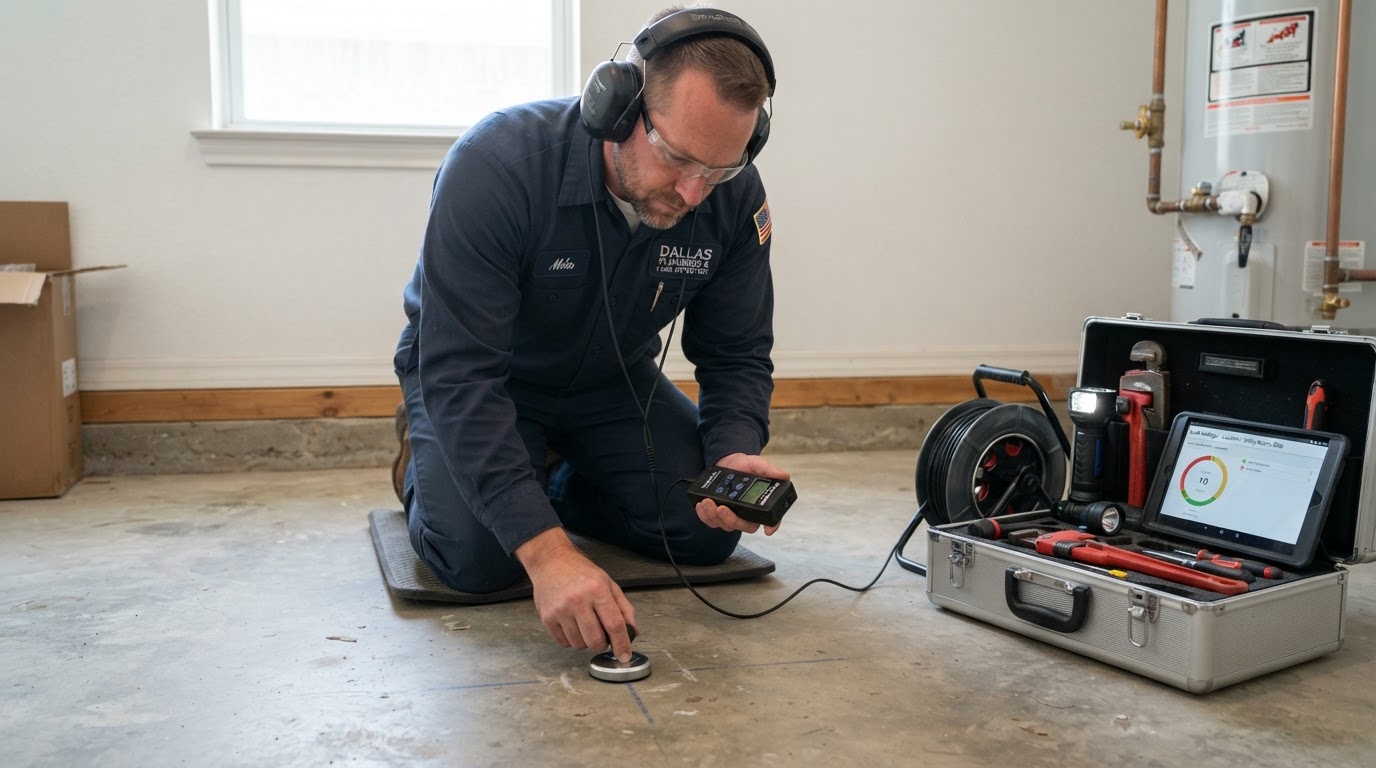
Step 2: Acoustic Leak Detection
Inspect and Test's acoustic leak detector guide explains that water forced through a small opening under pressure creates a hissing vibration. Ground microphones amplify it, and the operator sweeps the floor until the sound peaks above the leak. Indoors, the microphone may be walked across a slab in a grid until the signal peaks. The guide also notes the limits: plastic pipe absorbs and dampens vibration, drain and waste lines make little continuous noise so a camera is usually better for them, and background noise can mask the signal. That is why we combine acoustic detection with thermal imaging, pressure testing, or cameras rather than relying on it alone.
Step 3: Thermal Imaging
Teledyne FLIR explains that infrared cameras do not see water. They detect the temperature difference the water causes on the surface. A hot water line leak warms the floor above it, and a cold leak can cool it. FLIR notes that results depend on how severe and how deep the leak is, and that infrared gives clues but does not replace visual inspection. They also point out that pinless moisture meters read only about one inch below the surface, which is why thermal imaging is a primary tool on concrete.
Step 4: Camera Inspection and Hydrostatic Testing for Drain Lines
For drain lines, we use a different approach. The Foundation Performance Association notes that there are no published test standards for testing plumbing lines under residential foundations, but a typical sequence is a hydrostatic test, often around 30 minutes, done by pulling a toilet and filling the under-slab drain lines with water. If the water level drops, the line is leaking. Nick's Plumbing describes the process: test plugs seal off the drain system, it is filled with water to a set level, and a falling level means water is escaping. Isolation testing then narrows down the failing section by using test balls to block off parts of the line one at a time. The Foundation Performance Association also notes that cast iron drain pipe usually lasts 35 to 50 years but can fail in about 20. This Old House adds that video camera inspection lets plumbers spot crushed sections, corroded joints, and root intrusion without tearing up the slab.
Step 5: Marking the Spot and Writing the Detection Report
Once the tools agree on a location, we mark the spot on the floor and write up a detection report. That report documents which line is leaking, where the leak sits, and what we found with each method. You need that report for an insurance claim, for a second opinion, or just to understand what happens next. We write our reports so an adjuster can actually read them.
Slab Leak Detection Cost in DFW
Our slab leak detection in Dallas-Fort Worth typically runs $150 to $600. HomeAdvisor puts national leak detection at $150 to $400, so DFW runs a bit above the national low end, which lines up with metro labor rates. What drives the number is the number of lines tested, whether it is a supply line or a drain line, whether hydrostatic testing is needed, the size of the home, and how easy the cleanouts are to reach. Drain line isolation testing takes more time and equipment than a simple supply line pressure test, so it costs more. For the full picture on what repair costs after detection, see our slab leak repair cost guide.
What Happens After the Leak Is Found
Detection tells you where the leak is and which line is failing. Repair is a separate decision, and the right method depends on where the leak sits, what is on top of it, and how old the pipe is.
Repair Options: Direct Access, Tunneling and Rerouting
Direct access means breaking through the slab from inside the house to reach the pipe. It is the fastest and often cheapest option for a shallow, accessible leak, but it destroys the flooring above it. Tunneling means digging from outside the house under the foundation, so your floors stay intact and you can usually stay in the home, but it costs more in labor. Rerouting means abandoning the leaking section and running a new line overhead through the attic, which makes sense when the pipe itself is failing rather than just one spot. You can read about all three in detail through our slab leak detection and repair services page, and for Dallas-specific help see our slab leak repair in Dallas page.
Why the Foundation Should Be Checked Too
A leak under the slab does not just waste water. It wets the clay, which can heave or wash out and move the foundation. If you fix the pipe and ignore the slab, you may be back for a foundation repair next season. Read our article on how a slab leak can damage your foundation for the full explanation of that chain reaction.
Does Insurance Pay for Slab Leak Detection in Texas?
Texas Watch's overview of Texas homeowners policy coverage notes that coverage for under-slab plumbing leaks and resulting foundation damage depends heavily on the policy form. The older HO-B form covered these leaks, while the basic HO-A form generally does not. We cannot promise your policy will pay, so check your own policy's water damage and foundation sections with your agent. Keep the detection report, photos, and water bills, and read our guide on whether insurance covers foundation repair in Texas for the full picture.
Slab Leak Detection in Fort Worth and Across DFW
We provide slab leak detection across the full Dallas-Fort Worth Metroplex, including Dallas, Fort Worth, Grand Prairie, Garland, Irving, Grapevine, Rockwall, Frisco, Richardson, and Mesquite. Fort Worth homes often sit on Eagle Ford shale and limestone that moves differently than the Blackland Prairie clay under Dallas, so the failure pattern there is not always the same. If you are on the Tarrant County side, see our Fort Worth foundation repair page for more on how that soil behaves.
Frequently Asked Questions About Slab Leak Detection
How long does slab leak detection take?
Most residential detection visits take a few hours. Drain line isolation testing, which involves pulling a toilet and filling the under-slab lines with water, can take longer because each section has to be checked separately. We give you a time estimate before we start based on what we are testing.
Can a slab leak be found without breaking the floor?
Yes. We use acoustic listening equipment, thermal imaging, pressure testing, and camera inspection to pinpoint the leak before any concrete is opened. The goal of detection is to mark the exact spot so the access hole is as small as possible, not to start jackhammering and hope for the best.
Is slab leak detection accurate?
When multiple methods are combined, it is very accurate. No single tool works in every situation, which is why we layer acoustic detection, thermal imaging, pressure testing, and camera work. By cross-checking the results, we narrow the leak to a specific spot rather than a general area.
Should I shut off my water if I suspect a slab leak?
If the meter is running with everything off and you see active signs like warm spots or damp flooring, shutting the main valve limits water damage until detection. It also stops the leak from adding to your bill. Call us right after you shut it off so we can schedule detection.
Do I need a plumber or a foundation company?
A slab leak is both a plumbing problem and a foundation problem. A plumber can find and fix the pipe but usually cannot assess the slab. A foundation company can assess the slab but usually cannot touch the plumbing. A dual-licensed contractor like us handles both under one roof.
Schedule Slab Leak Detection in Dallas-Fort Worth
If your water meter is moving with everything off, you have warm spots on the floor, or your bill jumped for no reason, slab leak detection is the first step. Quality Foundation and Plumbing holds a Texas Master Plumber license (MP-37229) and a general contractor registration (TL-GC-002004), so we find the leak, fix the pipe, and check the slab under one roof with no subcontractor handoffs. Call 214-335-9437 or request a free estimate online to schedule slab leak detection in Dallas-Fort Worth.